
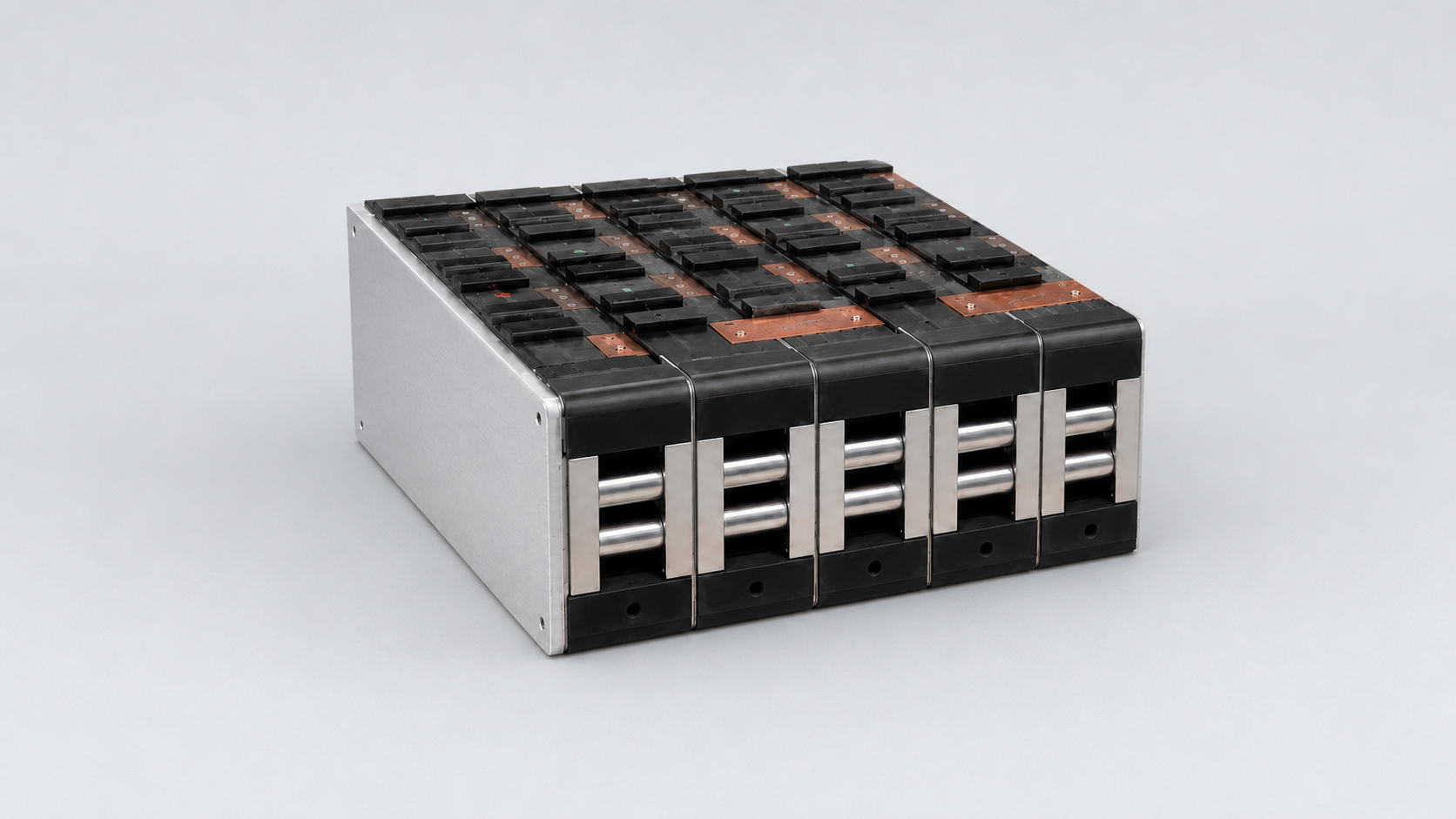
A high-power-density EV battery module packs the most usable energy and the highest sustained discharge current into the smallest, lightest possible space. In practice that comes down to four things working together: the right cell, low-resistance interconnects, cooling that keeps every cell in its safe window, and a battery management system precise enough to run the module near its real limits. Get all four right and you get a module that delivers full power without sagging, overheating, or being derated for safety.
Power density (watts per kilogram, or watts per liter) is not the same as energy density. Energy density tells you how far you can go. Power density tells you how hard you can push. A high-power-density EV battery module is engineered for the second number without throwing away the first, which is exactly the tension performance and motorsport programs live in.
Key takeaways
- Power density measures how fast a module delivers energy (W/kg), not how much it stores (Wh/kg).
- Cell selection sets the ceiling. 21700 cells balance high capacity with strong continuous and pulse current.
- Low-resistance, laser-welded interconnects and busbars cut the heat and voltage sag that limit real-world power.
- Thermal management keeps every cell in its window so the module is not derated to protect its hottest cell.
- A precise BMS lets the module run near its true limits instead of a conservative safety margin.
Cell selection sets the ceiling
Everything downstream is capped by the cell you start with. Cylindrical 21700 cells have become the workhorse of high-performance packs because they hit a hard-to-beat balance: high usable capacity, strong continuous and pulse discharge ratings, and low internal resistance relative to their packaging overhead. Lower internal resistance means less heat generated under load and less voltage sag when you ask for current, which is the whole game in a power-dense design.
Cell choice is also a system decision, not a spec-sheet pick. The cell's resistance, thermal behavior, and current rating dictate how the rest of the module has to be built. That is why EVDrive specifies cells against the actual duty cycle of the program, then designs the interconnects and cooling around that cell. Those same tradeoffs shape EVDrive's custom battery-system design work.
Interconnects and busbars: where power is quietly lost
Once the cells are chosen, the next bottleneck is getting current in and out of them cleanly. Every weld, busbar, and joint adds resistance, and resistance under high current means heat and lost voltage exactly when you want full power. A module can carry excellent cells and still underperform if the interconnect strategy is an afterthought.
High-power-density modules use wide, low-resistance busbars and tightly controlled welds (laser welding is common) to minimize the path resistance between cells. The goal is a module whose real delivered power matches the sum of its cells rather than bleeding off in the connections. This is unglamorous, hard-to-fake engineering, and it is one of the clearest places where in-house process control separates a premium module from a commodity one.
Thermal management keeps the whole module honest
Power density and heat are inseparable. Pushing high current generates heat, and heat is what forces a module to be throttled. If even a few cells run hot, the safe approach is to derate the entire module to protect them, which throws away the power you engineered in. Liquid cooling solves this by pulling heat out close to the cells and, just as importantly, keeping the temperature spread across the module tight.
A uniform thermal picture is what lets a module sustain high power instead of delivering it for a few seconds and then backing off. EVDrive applies liquid-cooling and validation experience when a program needs a module to hold its rated output through a real duty cycle, not just a single pull on a dyno.
The BMS turns design margin into deliverable power
The final piece is the electronics. A module is only allowed to deliver as much power as the management system can safely supervise. With coarse sensing or slow fault response, engineers have no choice but to leave a wide safety margin, and that margin is power you paid for but cannot use.
Accurate per-cell voltage and temperature sensing, tight balancing, and fast protection let a module run close to its true limits with confidence. That is the role of BetterBMS: it is the difference between a module rated conservatively on paper and one that actually delivers its design power in the field. Power density is ultimately a system property, and the BMS is the component that unlocks the rest.
Putting it together
A high-power-density EV battery module is not one breakthrough component. It is a cell chosen for its duty cycle, interconnects that do not waste current, cooling that holds every cell in its window, and a BMS precise enough to run all of it near the edge safely. When those four are designed together rather than bolted together, you get a module that is genuinely light, compact, and powerful at the same time. If you are spec'ing a performance or motorsport program, you can start a quote conversation with your target power, energy, and packaging constraints and our engineers will work the tradeoffs with you.
FAQ
What is power density in an EV battery module?
Power density is how much discharge or charge power a module delivers per unit of mass or volume, usually stated in watts per kilogram or watts per liter. It measures how hard a module can push current, not just how much total energy it stores.
What is the difference between energy density and power density?
Energy density (Wh/kg) is how much total energy a module holds. Power density (W/kg) is how fast it can deliver that energy. A long-range pack optimizes energy density, while a performance or motorsport module optimizes power density so it can sustain high current without overheating or sagging.
Why are 21700 cells used in high-power-density modules?
21700 cells balance high usable capacity with strong continuous and pulse current ratings, and their format keeps internal resistance and packaging overhead low. That combination lets a module hit both high energy and high power without the welding and cooling complexity of very large prismatic formats.
Does the BMS affect power density?
Yes. The battery management system sets how close to the cells' real limits a module can safely run. Accurate per-cell sensing, tight balancing, and fast fault response let a module deliver its full rated power instead of being derated for a safety margin the electronics cannot otherwise guarantee.