
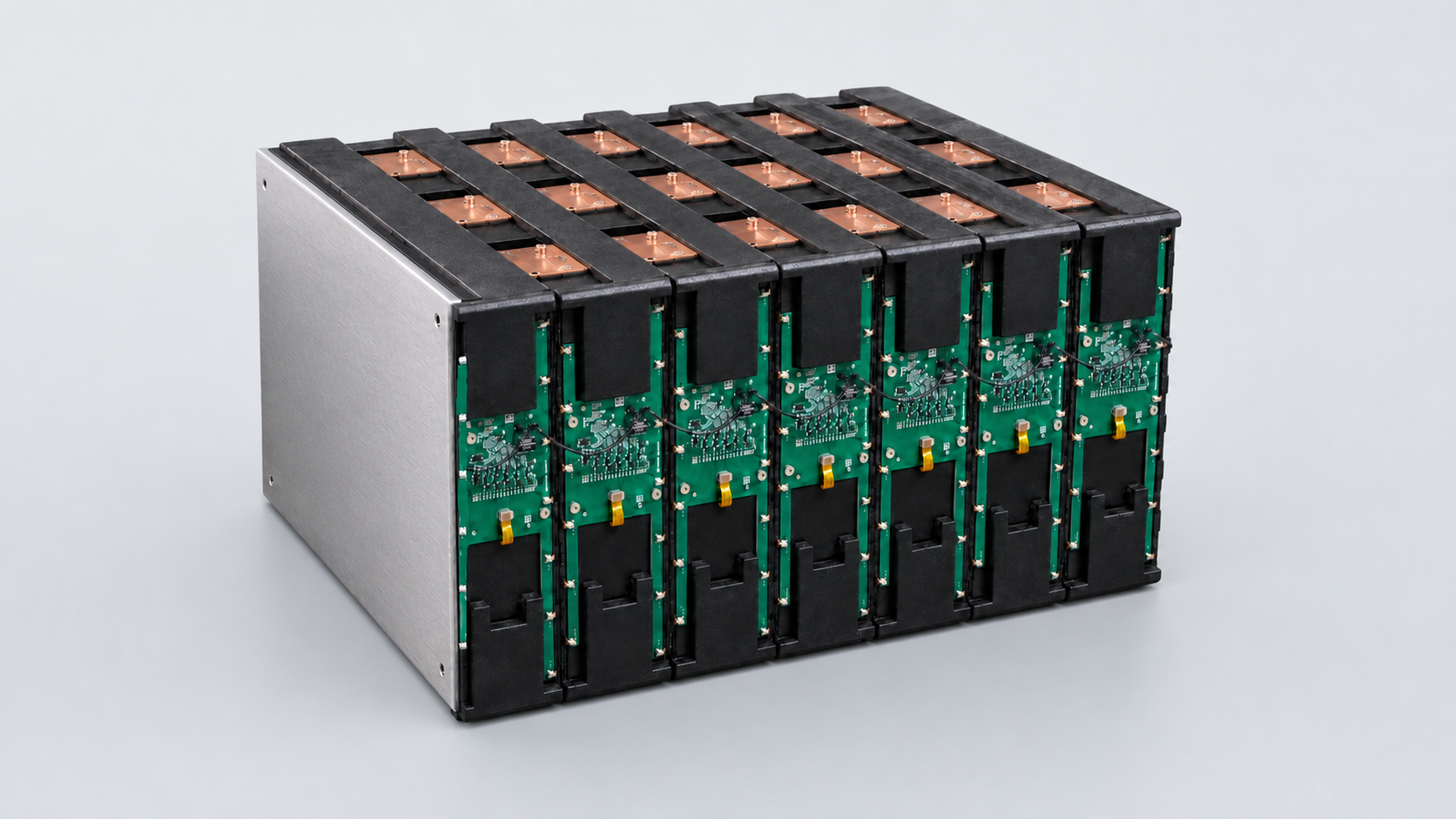
EV battery safety comes down to two disciplines working together: cell-level monitoring that sees trouble early, and fault tolerance that contains it before it spreads. A safe high-performance pack measures voltage and temperature at the individual cell or cell-group level, cross-checks those readings, and is built so that one bad cell cannot cascade into a pack-level event. Get those two right and most failure modes are caught while they are still small and recoverable.
This is the difference between a pack that simply works and one that stays safe under real stress: hard launches, fast charging, vibration, heat, and the slow drift of cells aging at slightly different rates. At EVDrive we design the cells, packaging, cooling, and management logic as one system, because safety lives in how those pieces interact, not in any single component.
Cell-level monitoring: seeing the pack at full resolution
Monitoring only at the pack terminals tells you the average. It hides the outlier that actually matters. Cell-level monitoring instead measures each cell or small cell group, so the management system can spot a unit that is sagging under load, charging out of step, or warming faster than its neighbors. That resolution is what turns a vague "something is wrong" into "this specific group, right now."
Temperature sensing is placed to catch the hottest realistic points, not just convenient ones, and voltage is sampled fast enough to see transient behavior during high-current events. The denser and more accurate the sensing, the earlier a developing fault becomes visible, and early is the entire game. Our BetterBMS is built around this high-resolution view, with the sampling and balancing headroom that demanding performance applications need.
Fault tolerance: contain, isolate, and keep going safely
Detection is only half of safety. The other half is what the system does once it sees a problem. Fault tolerance means a single failure does not become a single point of catastrophic failure. In practice that looks like layered defenses:
- Redundant sensing and plausibility checks. Readings are cross-verified so a drifting or failed sensor is flagged, not blindly trusted. This avoids both missed faults and nuisance shutdowns.
- Electrical isolation. When a cell group crosses a limit, the system can de-rate current, open contactors, or isolate the affected section to take stress off the fault.
- Physical containment. Cell spacing, venting paths, and barrier materials are arranged so heat from one cell is slowed before it can push a neighbor over the edge.
- Graceful degradation. Where the application allows, the pack reduces output and warns rather than dropping offline without notice, which matters most in motorsport and integrated systems where an abrupt cutout is its own hazard.
Thermal runaway: the failure mode worth designing against
Thermal runaway is the scenario every serious pack is engineered to resist: a cell overheats, which drives it hotter still, which can ignite adjacent cells in a chain. The defense is not a single feature but a sequence. Cell-level temperature monitoring catches the initial rise. The cooling system pulls heat away. Fault logic isolates the cell group. And the mechanical design buys time and breaks the chain so a localized event stays localized.
This is also where cell quality and packaging discipline pay off. Tighter cell selection narrows the spread between units, liquid cooling holds the whole pack in a steady thermal window, and deliberate spacing limits cell-to-cell propagation. Those choices are central to EVDrive's battery-system engineering, where cooling and containment are treated as part of the structure rather than added afterward.
Performance and safety are designed together
High discharge rates and dense packaging raise the thermal and electrical stakes, so it is tempting to assume performance trades against safety. In well-engineered hardware it does not. The same in-house control over cells, cooling, and the BMS that delivers the performance also delivers the monitoring resolution and fault margins that keep the pack inside safe limits. Treating them as one problem, owned by one engineering team, is what lets a pack be both fast and trustworthy.
Key takeaways
- Cell-level monitoring measures voltage and temperature per cell or cell group, catching outliers a pack-level reading would hide.
- Fault tolerance layers redundant sensing, electrical isolation, physical containment, and graceful degradation so one fault does not cascade.
- Thermal runaway is resisted by a sequence: early detection, active cooling, isolation, and mechanical containment that breaks cell-to-cell propagation.
- Cell selection, liquid cooling, and tight monitoring margins let a pack be high-performance and safe at the same time.
- Safety is strongest when cells, cooling, packaging, and the BMS are engineered as one system.
If you are scoping a pack where a battery failure is not an acceptable outcome, the safety architecture should be specified up front, not bolted on. Request a quote with your application and target specs and a real EVDrive engineer will walk through the monitoring and fault-tolerance approach that fits.
FAQ
What is cell-level monitoring in an EV battery?
It means the battery management system measures voltage and temperature at the individual cell or cell-group level rather than only at the pack terminals. That resolution lets the system catch a single weak or warming cell long before it affects the whole pack, which is the foundation of early fault detection.
How does fault tolerance prevent thermal runaway?
It combines early detection, electrical isolation, and physical containment. The BMS detects an abnormal cell, opens contactors or isolates the affected group, and the mechanical design (spacing, venting, and barriers) slows heat from spreading cell to cell, buying time and reducing the chance a single failure escalates.
Why does redundant sensing matter for battery safety?
A single sensor can drift or fail. Redundant sensing and plausibility checks let the system cross-verify readings, so a faulty sensor is flagged rather than trusted blindly. This prevents both missed faults and false trips that would force unnecessary shutdowns.
Does higher performance mean lower safety?
Not when the pack is engineered for it. High discharge rates and tight packaging raise thermal and electrical stress, but disciplined cell selection, liquid cooling, and tighter monitoring margins keep the pack inside safe limits while delivering performance. Safety and performance are designed together.