
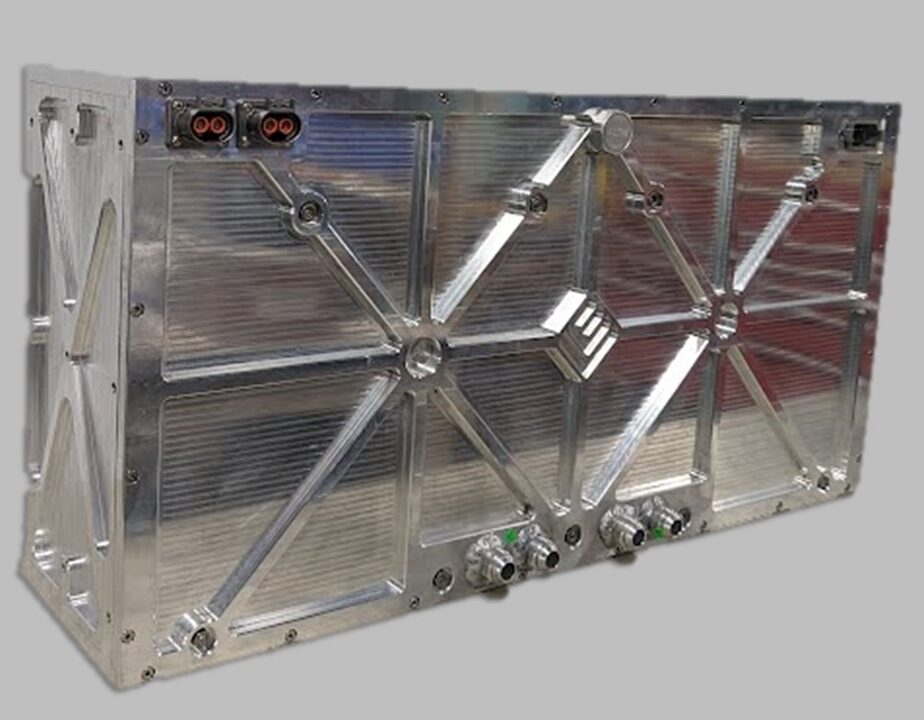
EV battery pack design for high-performance applications comes down to four decisions made together: the cell, the thermal system, the mechanical structure, and the battery management system. Get those four aligned and a pack delivers repeatable peak power without overheating or premature wear. Treat them separately and the pack will derate, sag, or fail under real load.
The hard part is not any single component. It is that every choice constrains the others. A higher-current cell needs more cooling. More cooling adds mass and packaging. The structure has to carry crash and vibration loads while leaving room for coolant paths and busbars. This article walks through how the EVDrive engineering team approaches each layer when engineering battery systems for OEMs, motorsport programs, and performance integrators.
Key takeaways
- High-performance pack design is a balance of cell, cooling, structure, and BMS, not a parts list.
- 21700 cylindrical cells offer a strong mix of energy density and high continuous and peak current.
- Liquid cooling keeps cells in their optimal window so peak power stays repeatable instead of derating.
- Mechanical design carries crash and vibration loads while protecting cells and coolant paths.
- A tightly integrated BMS turns a cell stack into a safe, measurable, controllable pack.
Cell selection sets the ceiling
The cell defines what the pack can do before any other engineering work happens. For high-performance applications, the 21700 cylindrical format is a common starting point because it pairs solid energy density with the ability to push high continuous and peak current, and because its thermal behavior is well understood and predictable at scale. The decision is not simply "the highest energy cell." A pack tuned for sustained track laps weights toward thermal headroom and cycle life, while a launch-focused build leans on peak discharge. EVDrive evaluates cells per application and configures the series and parallel architecture around the target voltage and capacity. Those choices feed directly into custom system design.
Thermal management protects the performance
Power makes heat. Under hard, repeated use the difference between a pack that holds its numbers and one that quietly backs off is almost always the cooling system. Cells have an optimal temperature window, and once they climb out of it the management system limits current to protect them, which the driver feels as lost power. Liquid cooling moves heat out of the cells fast enough to keep the whole pack in that window across an entire session, not just the first pull. Good thermal design also means even cooling: if one region of the pack runs hotter than the rest, those cells age faster and drag down the group. Coolant routing, cell spacing, and the cooling interface all get designed together rather than bolted on afterward.
Mechanical structure and packaging
A high-performance pack lives in a vehicle that brakes hard, corners hard, and has to survive a crash. The enclosure and internal structure carry those loads while holding the cells, busbars, and coolant channels in precise position. Packaging is where the trade-offs become physical: every millimeter spent on structure or cooling is a millimeter not spent on cells, so the geometry has to be efficient. This is also where in-house engineering pays off. Designing the structure around the actual mounting points and envelope of the target vehicle produces a tighter, lighter, more serviceable pack than forcing a generic module to fit a space it was never shaped for.
BMS integration ties it together
A stack of cells is not a pack until the battery management system makes it safe and measurable. The BMS monitors voltage and temperature, balances cells, enforces protection limits, and reports state of charge and state of health. In a high-power pack it has to measure and react quickly, because conditions change fast under heavy current. EVDrive can integrate the BetterBMS alongside the cells and cooling so that protection thresholds, balancing strategy, and telemetry match the hardware they are managing. Pairing the BMS to the pack from the start, rather than adapting an off-the-shelf controller after the fact, is what keeps a performance pack both fast and trustworthy.
Designing to the application, not the catalog
Voltage, capacity, peak current, packaging, and mounting are all variables, and the best pack is the one whose variables were set by the vehicle it serves. That is the throughline across cell, cooling, structure, and BMS: every layer is decided in context, with the others in view. When the four are engineered as one system, the result is a pack that delivers its rated performance lap after lap and holds up over its service life. If you have a target spec in mind, you can start a quote conversation and talk it through with an engineer.
FAQ
What cell format is best for high-performance EV battery packs?
The 21700 cylindrical cell is a common choice because it balances energy density with high continuous and peak current and has proven, predictable thermal behavior. EVDrive evaluates cell format against each application's power, energy, thermal, packaging, and service requirements.
How important is thermal management in performance pack design?
It is central. Sustained high power generates heat that degrades cells and triggers thermal limiting if it is not removed. Liquid cooling keeps cells inside their optimal window so the pack delivers repeatable peak performance instead of derating after a few hard pulls.
Why does the BMS matter for a high-performance pack?
The BMS protects cells, balances them, and reports accurate state of charge and state of health. In a high-power pack it must measure fast and act fast. EVDrive can integrate the BetterBMS so protection and telemetry are matched to the cells and cooling from the start.
Can a high-performance pack be designed for my specific application?
Yes. Voltage, capacity, peak current, packaging, and mounting are all design choices. EVDrive engineers battery systems and pack architectures for OEMs, motorsport programs, and integrators, so the geometry and electrical targets match the real vehicle rather than forcing a generic module to fit.