
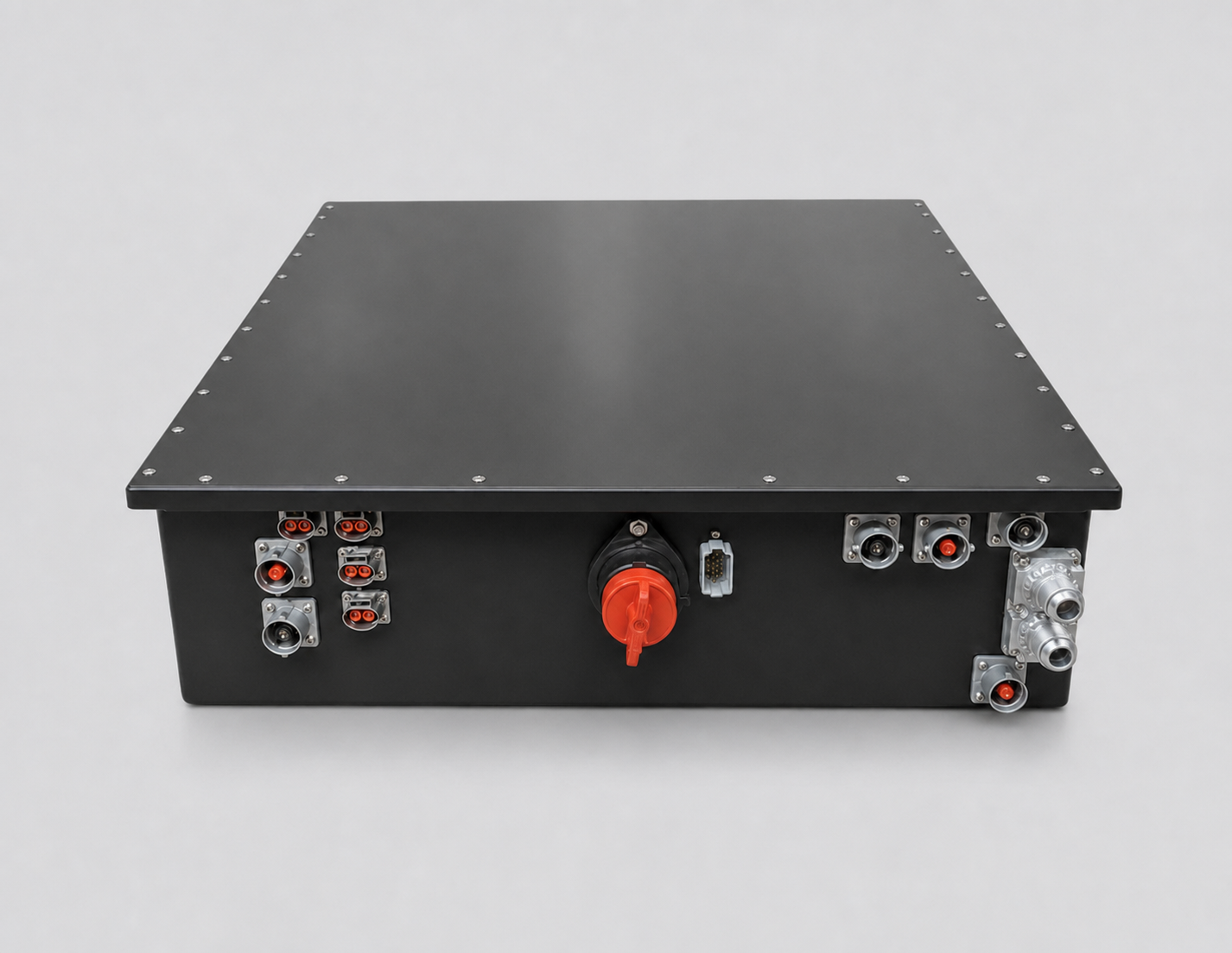
Custom EV battery packs for small OEMs are purpose-built energy systems that match a specific vehicle or machine to the right cells, mechanical layout, and battery management system, rather than forcing your product to fit an off-the-shelf box. For a small original equipment manufacturer, that means a pack engineered around your duty cycle, your packaging envelope, and your certification path. The win is not just energy stored. It is a validated, integrated system you can put into production with confidence.
Below is how the program actually works when you do not have a battery engineering team of your own, and what separates a pack that ships from one that stalls in testing.
Key takeaways
- A custom pack is matched to your real duty cycle, not a generic spec sheet, so it delivers the power, range, and cycle life your product needs.
- Small OEMs do not need an in-house battery team. The cell selection, module architecture, and BMS come engineered together.
- The battery management system is the safety-critical core, not an accessory. It belongs in the design from day one.
- Application-specific architecture lets the battery system conform to unusual enclosures and low-volume requirements.
- Prototype, validate, then scale. A proven module platform shortens the path from one unit to a production run.
Start with the duty cycle, not the cell
The most common mistake small OEMs make is choosing a cell or a target capacity first. The right starting point is the duty cycle: how hard the product discharges, how often, in what ambient conditions, and how long it has to last. A delivery platform that sips current all day has a very different ideal chemistry and thermal design than a performance machine that pulls hard, brief peaks. Define that envelope clearly and the rest of the pack follows from it.
EVDrive provides custom battery-system engineering around the actual envelope, duty cycle, and power and energy targets rather than rounding the project to whatever a stock module happens to offer.
The BMS is the pack, not an add-on
For a small OEM, the battery management system is where a project most often gets stuck. A pack is only as safe and as durable as the system watching every cell. Balancing, temperature limits, current limits, state-of-charge accuracy, and fault response all have to be engineered with the cells they protect, not selected from a catalog after the fact.
The BetterBMS can be configured as part of the battery architecture so protection logic, balancing, thermal limits, communications, and fault handling are matched to the system it controls. You get a system that has been proven together, which is what certification bodies and your own field reliability data will ultimately demand.
Built in-house, so it fits your product
Small-OEM packaging is rarely a clean rectangle. Mounting points, cooling access, service clearances, and weight distribution are all constrained by a chassis you have already committed to. EVDrive can lay out the battery architecture around the enclosure rather than the other way around, then define the design, integration, validation, sourcing, and production-readiness work needed for the intended volume.
Prototype, validate, then scale
A disciplined program moves in stages. First, a validation prototype confirms the electrical, thermal, and mechanical design against your real duty cycle. Then a small pilot batch proves repeatability and feeds your own integration and safety testing. Only then does it make sense to commit to a production run. Because the module platform and the BetterBMS are already proven, each stage starts from solid ground instead of a blank sheet, which is how a small team gets to a shippable product without a multi-year battery effort.
When you are ready to scope a program, the fastest path is to share your duty cycle and packaging constraints and start a quote conversation. A real engineer reviews it, not a sales script.
FAQ
What is the minimum volume for a custom EV battery pack?
EVDrive supports prototype and low-volume battery programs through engineering, architecture, integration planning, and validation. The right approach depends on duty cycle, packaging constraints, production resources, and the certification timeline.
How long does a custom EV pack program take?
Most small-OEM programs move from a defined spec to a validated prototype in weeks rather than months, because the module architecture and the BetterBMS are already proven. The longest variable is usually your own enclosure and integration testing, not the pack itself.
Do I need my own battery management system?
Not necessarily. BetterBMS can provide a configurable control foundation so cell balancing, thermal limits, communications, and fault handling are engineered with the battery system rather than bolted on afterward.
Can a custom pack fit an unusual enclosure shape?
Yes. EVDrive can engineer the battery architecture around the packaging envelope, mounting points, service access, cooling interfaces, and duty cycle rather than forcing the chassis to accept a generic box.