
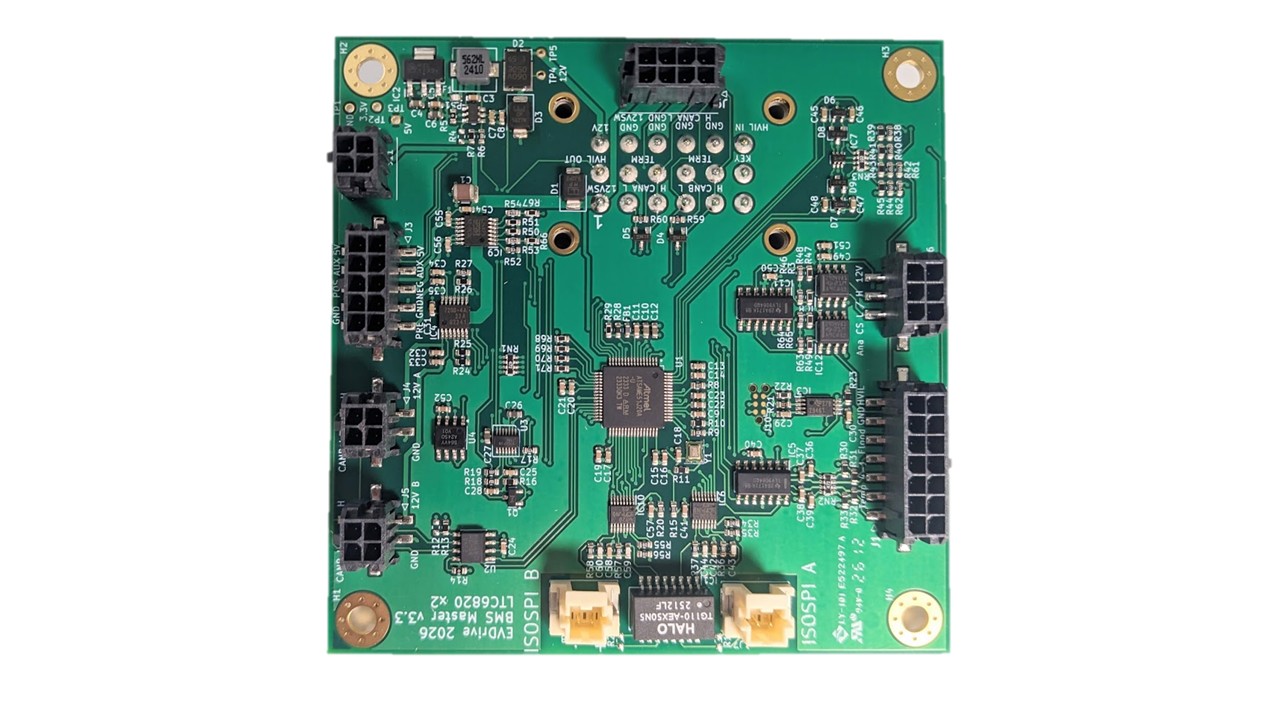
To choose an EV battery management system (BMS), match it to your exact cell chemistry, cell count, and peak current, then confirm it delivers four things: hard safety limits on voltage and temperature, real cell balancing, an accurate state-of-charge and state-of-health estimate, and a documented communication interface. A BMS that fits the pack on those four points is reliable. One that is merely "close enough" becomes the weakest part of the build.
The BMS is not an accessory. It is the safety and intelligence layer of every lithium pack, and the difference between a pack that performs predictably for years and one that fails early often comes down to how well the BMS was chosen and configured. Below is how we evaluate a BMS when we engineer packs at EVDrive.
Key takeaways
- Match the BMS to your real cell chemistry, cell count, and peak current, not a generic spec sheet.
- Non-negotiable functions: per-cell voltage and temperature monitoring, hard protection limits, and contactor control.
- Confirm balancing current is sized to your cell capacity, and verify CAN communication is documented.
- State-of-charge and state-of-health accuracy directly affect range, performance, and pack longevity.
- For high-discharge performance builds, a purpose-built BMS beats off-the-shelf because its limits fit the actual pack.
Start with the cell chemistry and pack topology
Every meaningful BMS decision flows from the cells. A BMS tuned for one chemistry will set the wrong voltage windows for another, and the wrong windows either waste capacity or push cells into damage. Before comparing products, write down your chemistry (for example NMC in a 21700 format), your series and parallel configuration, and your peak and continuous current. The BMS has to support your full series cell-group count, sense every group, and carry or supervise your current path without becoming the bottleneck. In a well-engineered liquid-cooled system, the cells and pack architecture are defined first, then the BMS is matched to that topology rather than the other way around. EVDrive applies that discipline in custom system design.
The safety functions that are non-negotiable
A credible EV BMS must monitor every series cell group's voltage and read temperature at multiple points across the pack. From those measurements it has to enforce hard limits: over-voltage, under-voltage, over-temperature, under-temperature, over-current, and short-circuit response. When a limit is crossed, the BMS must be able to open the contactors and bring the pack to a safe state. If a BMS cannot see every cell group individually, it cannot protect the pack properly, because a single failing group can sit hidden behind a healthy pack average. Per-cell-group visibility is the line between a real BMS and a glorified voltmeter.
Balancing: where usable capacity is won or lost
Cells drift apart over time. Without balancing, the highest cell group hits the upper limit first on charge and the lowest hits the floor first on discharge, so the whole pack is capped by its weakest member. Check that the balancing current is sized to your cell capacity, otherwise the BMS will never catch up to real-world drift. Passive balancing is adequate for many builds. Active balancing earns its added cost in demanding duty cycles where energy throughput is high and every usable amp-hour matters. Decide this deliberately based on how the pack will actually be used.
State estimation and communication
A BMS reports two numbers the rest of the vehicle depends on: state of charge (how much energy is left) and state of health (how the pack has aged). Poor estimation shows up as a range gauge you cannot trust or a pack that derates unexpectedly under load. Ask how the BMS estimates both and how that holds up at high current and across temperature. Just as important is communication. CAN bus is the standard for EV and motorsport because chargers, inverters, vehicle controllers, and data loggers all speak it. Confirm the BMS exposes a documented CAN protocol so every device in the system can read pack state cleanly. Our BetterBMS was built for exactly this role: full per-cell-group visibility, robust protection, and clean integration with the rest of a performance drivetrain.
Off-the-shelf or purpose-built
An off-the-shelf BMS can be a reasonable fit for a low-current, low-stress pack with generous packaging. The calculus changes for performance EV, motorsport, and OEM programs. High discharge rates, tight thermal envelopes, and dense packaging mean the protection limits and thermal behavior have to match the real pack, not a generic reference design. That is the case for a BMS matched to your build, and it is work EVDrive supports through consulting, system design, integration, and BetterBMS configuration. If you are scoping a pack, tell us the chemistry, the configuration, and the current target, and we will engineer the BMS to fit. You can start a quote conversation with those specs to start.
FAQ
What does a BMS actually do in an EV battery pack?
It measures every cell group's voltage and temperature, enforces safe operating limits, balances cells, estimates state of charge and state of health, controls the contactors, and reports pack status to the vehicle. It is the safety and intelligence layer that keeps a high-energy pack inside its limits.
Should I buy an off-the-shelf BMS or a purpose-built one?
Off-the-shelf can work for low-stress, modest-current builds. For performance EV, motorsport, or OEM programs with high discharge rates and tight packaging, a BMS matched to your exact cell chemistry, cell count, and current profile is far more reliable because its protection limits and thermal model fit the real pack.
How important is cell balancing when choosing a BMS?
Very. Without effective balancing, the weakest cell group caps the whole pack's usable capacity and ages faster. Confirm the balancing current is sized for your cell capacity, and decide whether passive balancing is enough or active balancing is justified for your duty cycle.
What communication interface should an EV BMS use?
CAN bus is the standard for EV and motorsport integration because it is robust, well documented, and understood by chargers, inverters, and vehicle controllers. Confirm the BMS exposes a documented CAN protocol so your charger, drivetrain, and data logger can read pack state cleanly.